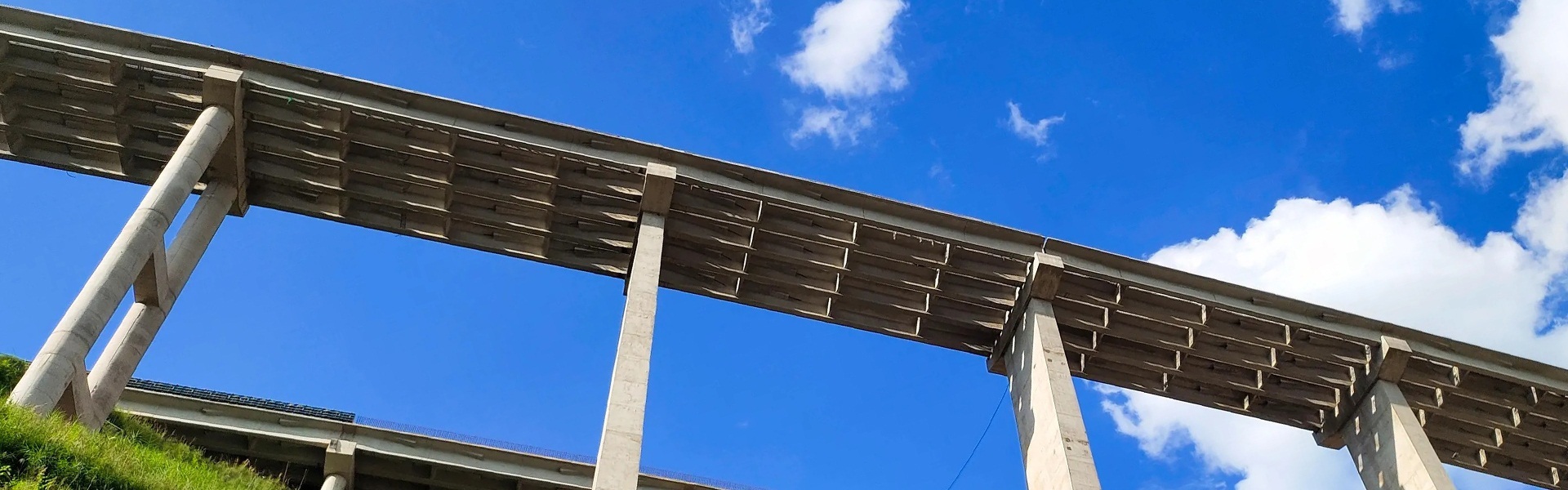
Development trends of highway bridges in China
Release Time:
2019-08-27
CCTV's "Focus Interview" recently interviewed Dr. Shi Xuefei, a professor at Tongji University who participated in the design of Qianjiang Third Bridge, and Zhu Yulong, deputy director of Hangzhou Municipal Transportation Bureau. They both believe that overloaded trucks were only the trigger for the bridge collapse; the root cause lies in the bridge's "congenital defects".
CCTV's "Focus Interview" recently interviewed Professor Shi Xuefei, PhD, from Tongji University, who participated in the design of the Qianjiang Third Bridge, and Zhu Yulong, deputy director of the Hangzhou Municipal Transportation Bureau. They both believe that overloaded trucks were only the trigger for the bridge collapse; the root cause lies in the bridge's "congenital defects."
What exactly are the "congenital defects" of the Qianjiang Third Bridge? Yangcheng Evening News reporters collected three sets of "2006 Major Repair Meeting Minutes" of the Qianjiang Third Bridge and asked Professor Lu from South China University of Technology, who has been researching bridge engineering projects for many years, to analyze them item by item on August 1. Professor Lu stated that based on his understanding of the Qianjiang Third Bridge and analysis of the meeting minutes, it can be seen that: the construction quality of the bridge definitely had problems; it is also possible that the design unit, in pursuit of aesthetics and under the constraint of construction costs, did not leave enough room in the design, "not fully anticipating the long-term overload of the bridge, causing the bridge to suffer incurable diseases during its 'prime years'."
Three Major Repair Minutes: Significant Damage to the Main Bridge
The three sets of Qianjiang Third Bridge meeting minutes obtained by Yangcheng Evening News reporters all came from the Hangzhou Municipal Transportation Bureau. They are: "Minutes of the Qianjiang Third Bridge Major Repair Project Bridge Deck Design Adjustment Plan Review Meeting" (Hangjiao Minutes [2006] No. 11), "Minutes of the Qianjiang Third Bridge Major Repair Project Phase 1 Work Summary Meeting" (Hangjiao Minutes [2006] No. 24), and "Minutes of the Qianjiang Third Bridge Major Repair Project Technical Issues Expert Meeting" (Hangjiao Minutes [2006] No. 49). They all address the largest repair of the Qianjiang Third Bridge in recent years—from September 2005 to October 2006, Hangzhou invested 68 million yuan in a year-long semi-closed major repair and landscape reconstruction of the Qianjiang Third Bridge, including the main bridge deck system renovation, bridge damage repair, structural reinforcement, and landscape renovation. In document No. 24, the government department proposed that the original cost of the major repair project was only within 35 million yuan. In other words, the actual cost of the major repair was double the planned amount and exceeded 11% of the bridge's initial construction investment of 600 million yuan.
The three minutes clearly demonstrate that the bridge, less than 9 years after opening, was already seriously damaged.
Document No. 11 records the "Hangzhou Qianjiang Third Bridge Major Repair Project Bridge Deck Design Adjustment Plan Review Meeting" held by the Hangzhou Municipal Transportation Bureau on March 8, 2006. The minutes clearly state that the Qianjiang Third Bridge deck had damage, which "was revealed after the two paving layers on the upstream section of the Nanlian bridge deck were removed," and in addition, the "box girder top plate defects" were also obvious.
Document No. 24 records the "Qianjiang Third Bridge Major Repair Project Phase Work Summary Meeting" held by the Hangzhou Municipal Transportation Bureau on April 28, 2006. The minutes clearly state that the bridge had "defects that affect vehicle traffic on the bridge deck and affect the structural safety and durability," and proposed that the "major repair must be thorough and leave no hidden dangers"; the bridge box girders had cracks, and the box girder segments also had defects; vertical prestressing was missing or failed; and the box girder top plate had numerous defects, including "hanger holes, exposed main reinforcement, and exposed longitudinal and transverse prestressing."
Document No. 24 mentions that the repair principle is to "give equal weight to load reduction, reinforcement, and line control." Professor Lu from South China University of Technology stated that this shows that according to the bridge inspection status, experts believed that the bridge was already overloaded, so they proposed to reduce the load. Professor Lu pointed out that proposing the above repair principles is generally due to the bridge structure being fragile or poor construction quality.
Construction Quality Has at Least "Four Major Crimes"
Based on the three minutes, Professor Lu believes that the bridge's construction quality has at least "four major crimes."
1. Box Girder Cracks as a "Killer"
The first crime is box girder cracks, which directly threaten the bridge's lifespan. Professor Lu told reporters: "From the perspective of reinforced concrete structures, if there are cracks in the box girder, external air and water can easily penetrate the box girder, causing internal steel bar corrosion. This will weaken the load-bearing capacity of the bridge section on the one hand, and the volume of the corroded steel bars will expand on the other hand, gradually expanding and cracking the concrete, accelerating the disintegration of the bridge."
In fact, as early as 1997 when the Qianjiang Third Bridge was completed, the completion acceptance report showed that there were already seven quality problems on the main bridge. The most serious one was box girder cracks, totaling more than 200, with the widest being 0.58 mm and the longest being 4.3 meters.
Professor Lu stated that general reinforced concrete structures are allowed to have cracks, but the width is limited—generally, the national limit is 0.2-0.25 mm, and strictly designed projects will require no more than 0.15 mm.
The Qianjiang Third Bridge deck that collapsed on July 15 this year was precisely the Nan Yinqu box girder that was not included in the 2005 major repair. In addition to the collapsed section, there are actually multiple cracks more than 10 centimeters wide on the Nan Yinqu bridge, ranging from three to four meters to seven or eight meters in length. It can be seen that if not repaired in time, cracks less than 1 centimeter in the past can expand tens of times after more than 10 years of deterioration, becoming a bridge killer.
2. Insufficient Vertical Pulling Force of Box Girders
The second crime is insufficient vertical pulling force of the box girders. The minutes note that "the missing and failed vertical reinforcement in the original structure should be updated and supplemented with all efforts, and the monitoring of vertical reinforcement tensioning and grouting quality should be strengthened." Professor Lu explained that the so-called "vertical reinforcement" is, simply put, the "pulling force" acting on the bridge box girder and perpendicular to the bridge deck.
"The Qianjiang Third Bridge has few piers, and the vertical force of the bridge is to improve the structural force. The document mentions 'grouting quality,' which is likely because the grouting of the prestressed steel bars in the box girder was not done well, which is a typical construction error." Professor Lu said that generally, prestressed steel bars (i.e., high-strength steel bars) are embedded in the box girder, and empty pipes are pre-embedded during the pouring of the box girder, then the prestressed steel bars are inserted into the empty pipes, and the empty pipes and steel bars also need to be grouted. There should be no gaps between the steel bars, empty pipes, and box girders. After the three are integrated, rainwater and air will not corrode the steel bars. However, judging from the minutes, this step was clearly not done well during construction, resulting in gaps between the steel bars and empty pipes, and the tensioning force of the steel bars themselves was also unqualified. These directly threaten the load-bearing safety of the bridge.
3. Concrete Does Not Meet Requirements
The third crime is that the concrete used to paste the webs does not meet the technical requirements. The minutes mention that "before pasting the steel strips to the webs, the actual quality of the concrete (commonly known as cement) at the bonding point should be confirmed. In loose or defective areas, the pasting of steel should be adjusted according to the actual situation and the corresponding process and methods should be optimized." Professor Lu reasoned inversely and believed that the concrete used in this part also had problems. There are two possibilities for loose and defective areas: one is that the cement grade is insufficient, high-grade cement is required by design, but low-grade cement with a lower price was actually used; the other is that the construction was not in place, and the pressed concrete did not meet the strength requirements, or honeycomb defects occurred when laying the concrete.
4. Numerous Defects in Box Girder Top Plates
The fourth crime: numerous defects exist in the box girder top slab. The minutes mention that "the box girder defects should be designed and handled promptly. The reinforcement of the No. 4 and No. 3 webs of Nanlian section and the No. 4 web of box girder No. 8 should be arranged as soon as possible. Numerous defects on the box girder top slab (lifting hole, exposed main reinforcement, exposed longitudinal and transverse prestressed reinforcement, etc.) should be subject to special design and treatment." Professor Lu stated that these are obvious construction defects.
The so-called "exposed prestressed reinforcement" refers to steel bars that should have been embedded in the concrete but appear on the outside. If the steel bars are not properly positioned during construction, they will "run" out of the concrete protection layer, exposing them and making them susceptible to rust. "Exposed main reinforcement" means that the longitudinal or transverse ordinary steel bars on the top slab of the box girder outside the bridge "run" out of the box girder, also prone to rust.
Possible "fifth crime" in design
Insufficient safety factor margin
There are problems with the bridge construction quality. Are there any inherent defects in the design?
Comparing it to the 74-year-old Qianjiang River Bridge that remains standing, Professor Lu believes that in terms of design, the Qianjiang Third Bridge has a significantly insufficient safety factor margin, which is considered the "fifth crime." He said: "The Qianjiang River Bridge was built according to the load of a railway bridge, and each pier is a solid pier. Even heavy trucks can easily bear the load, while the Qianjiang Third Bridge, in order to be light and beautiful in design, may have insufficient safety factor margin. Coupled with the original poor construction quality and frequent passage of trucks, it is inherently deficient and suffers from neglect, naturally becoming afflicted with diseases early on."
Why couldn't the designers set a higher safety factor? Professor Lu analyzed:
First, cost control. The higher the safety factor, the higher the design cost. The reporter learned that the construction of the Qianjiang Third Bridge did encounter funding problems. The Municipal Transportation Bureau raised funds while constructing the bridge, and had successively negotiated joint ventures with several Hong Kong companies, raising funds twice in 1994 and 1996 to finally complete the construction.
Second, the national design standards at that time were relatively low. The Qianjiang Third Bridge followed the "85 edition" national standard, which, as the most authoritative mandatory standard, did not consider the increasing pressure on China's transportation development and the insufficient load capacity margin, and was widely criticized by the industry.
Third, the bridge pursued "appearance" excessively. The Qianjiang Third Bridge is Zhejiang Province's first modern cable-stayed bridge with world-advanced technology, creating many firsts in the history of Chinese bridge construction. "The Qianjiang Third Bridge uses cables, and the main bridge has few piers, and the bridge body is relatively thin. This type of bridge is light and beautiful in appearance. Compared with the Qianjiang River Bridge, the former is like a Hangzhou beauty, while the latter is like a Northeast man. But since it's called a 'beauty,' its ability to endure hardship is somewhat lacking." Professor Lu said that, to his understanding, the Qianjiang Third Bridge has a single transverse cable, while the Guangzhou Haiyin Bridge, which is also a cable-stayed bridge, has three transverse cables. "This is also the price paid for sacrificing safety factor for aesthetics and economy."

Mobile QR Code
Liuzhou Jianqiao Prestressed Intelligent Equipment Co., Ltd.
Email:1370838748@qq.com
Address: No. 99, Xiaolongwen Road, Liunan District, Liuzhou City
Mobile:+86 13978051832
Mobile:+86 13877223782
Whatsapp:+86-13687716583
Copyright © 2025 Copyright: Liuzhou Jianqiao Prestressed Intelligent Equipment Co., Ltd.